The global demand for durable, energy-conscious entrances is reshaping the door manufacturing industry. An Aluminum Entrance Door now serves more than a decorative function. It must manage heat, rain, security, noise, and daily traffic at the same time.
The International Energy Agency’s Buildings 2023 report states that buildings consume about 30% of global final energy. This figure highlights the importance of better envelopes, including doors and windows. Grand View Research also identifies construction growth, renovation, and energy-efficient products as major drivers of the aluminum doors market. These trends explain why manufacturers increasingly combine thermally broken frames, insulated cores, multi-point locks, and weather-resistant coatings.
Sustainability matters too. The International Aluminium Institute reports that recycled aluminum may require only about 5% of the energy used for primary aluminum production. However, recycled content alone does not prove responsible manufacturing. Buyers should examine environmental product declarations, alloy specifications, factory quality systems, warranty terms, and testing results. Look for evidence.
This Top 10 list evaluates manufacturers through practical criteria, including product engineering, production capacity, international reach, customization, thermal performance, finish durability, and installation support. Standards such as EN 14351-1, ASTM testing methods, and ISO-certified management systems can provide useful reference points. Yet comparisons are not perfectly universal. Climate zones, building codes, hardware preferences, and project budgets vary widely. Some public data also remain incomplete.
The selected companies represent different strengths, from high-volume architectural systems to customized residential entrances. Their differences matter. A coastal villa needs corrosion resistance, while a cold-climate commercial building demands stronger thermal control. This review offers a careful starting point, not an unquestionable verdict.
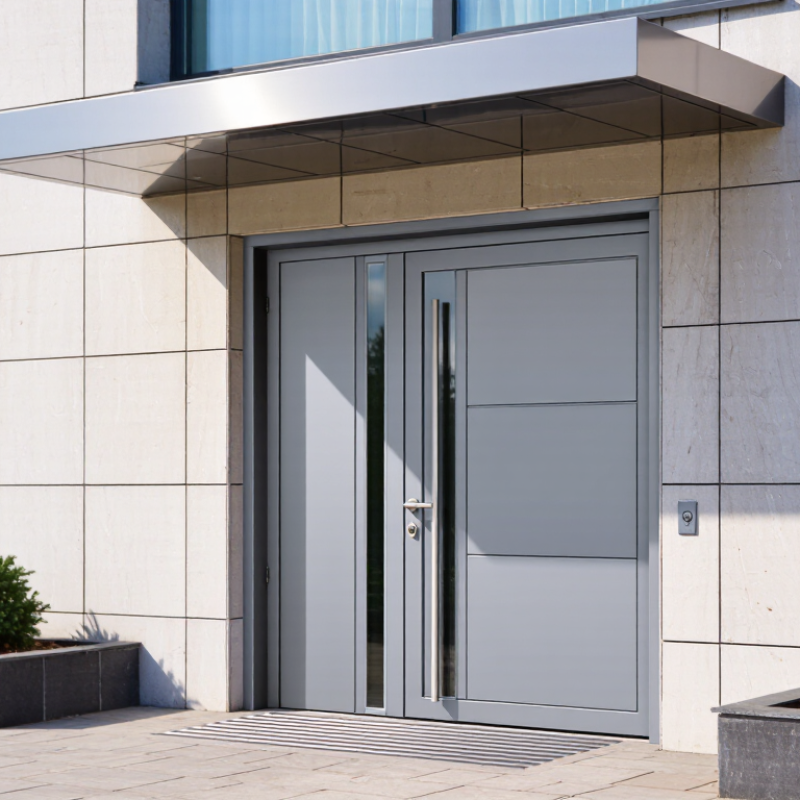
Industry Scope and Definition of Aluminum Entrance Door Manufacturers
Aluminum entrance door manufacturers design, process, assemble, and test exterior entry systems. Their products may serve homes, offices, hotels, schools, and public buildings. The category includes companies that extrude profiles, fabricate frames, assemble door leaves, and integrate glazing, seals, locks, and hinges. Distributors alone should not qualify.
The boundary is not as neat as a product page suggests. Some manufacturers outsource extrusion but control engineering, assembly, and quality testing. Others sell complete systems while relying on independent fabricators. A credible industry ranking should therefore examine production control, certification, installed performance, and after-sales capability. Relevant indicators include air leakage, water penetration, wind resistance, thermal transmittance, recycled aluminum content, and documented environmental data.
The International Aluminium Institute places building and construction among the major global aluminum-use sectors, accounting for roughly one quarter of demand in commonly cited sector analyses. This supports the category’s importance, but it does not measure entrance doors specifically. The 2023 UNEP Global Status Report for Buildings and Construction reported that buildings and construction represented about 37% of global energy-related and process carbon emissions. Consequently, manufacturers increasingly document insulation, durability, repairability, and material recovery. Environmental Product Declarations under EN 15804 can improve comparison, although reporting boundaries still differ. That weakness deserves attention. A manufacturer may appear efficient while excluding transport, hardware, or replacement cycles from its assessment.
Industry scope includes manufacturers of aluminum-framed entrance doors for residential, commercial, institutional, and industrial buildings. The chart provides upstream supply context using estimated primary aluminum production by country, since no company or brand data is displayed.
Source: U.S. Geological Survey, Mineral Commodity Summaries 2024, Aluminum. Values represent estimated 2023 primary aluminum production in million metric tons and are used as an industry supply indicator.
Evaluating global aluminum door manufacturers requires more than comparing catalogue photos. Start with material evidence. Ask for the alloy grade, wall thickness, thermal-break design, and coating specification. A reliable supplier should provide test reports for air infiltration, water penetration, wind resistance, and acoustic performance. Details matter. Check whether these tests match the climate and building standards of the target market.
Factory experience becomes visible through process control. During a site visit, inspect profile storage, corner crimping, drainage paths, glass installation, and final inspection records. Traceability is important. Each batch should connect to production dates, component sources, and quality checks. Ask how rejected frames are handled. A clean showroom can hide inconsistent workmanship. Samples should include working corners, not only polished display panels.
Evaluate technical support after purchase. Clear shop drawings, installation guidance, spare hardware, and response times often matter more than a low quotation. Confirm warranty limits, coating maintenance, lead times, packaging methods, and export documentation. Regional code knowledge is valuable, but it should be supported by current certificates and practical references. Sustainability claims also need evidence, such as recycled-content data or controlled finishing processes. I would not judge a manufacturer from one impressive project. Small defects, like uneven gasket compression or a stiff lock, may reveal deeper issues. Ask for a real production sample.
Top 10 Aluminum Entrance Door Manufacturers Worldwide
The global aluminum doors and windows market continues to expand. Grand View Research estimates a steady growth rate through 2030, supported by urban construction and renovation demand. Aluminum remains attractive because it resists corrosion, supports slim frames, and requires limited maintenance.
Profile One represents large-scale extrusion expertise and supplies thermally broken entrance systems. Profile Two focuses on high-security doors with multi-point locking channels. Profile Three develops oversized pivot doors for luxury residences. Profile Four serves commercial projects with tested fire and smoke-control assemblies.
Profile Five emphasizes recycled aluminum and publishes environmental product declarations. Profile Six specializes in coastal buildings, where powder coatings and drainage design matter greatly. Profile Seven offers customized colors, concealed hinges, and narrow sightlines. Profile Eight targets energy-efficient housing and reports low U-values under regional testing standards.
Profile Nine combines automated fabrication with short production cycles. Profile Ten serves demanding institutional projects and emphasizes third-party certification. The World Bank and International Energy Agency both identify building efficiency as a major long-term construction priority. Door performance therefore depends on more than appearance. Installation accuracy, thermal bridging, gasket compression, and threshold drainage can change real results.
Some rankings remain imperfect. Market reports often measure complete door systems, not entrance doors alone. Buyers should verify laboratory data, warranty terms, coating thickness, and local installer experience before comparing manufacturers. A beautiful frame can still fail beside a poorly sealed threshold.
Top 10 Aluminum Entrance Door Manufacturers Worldwide
The leading ten manufacturers rely on precision extrusion, CNC cutting, and controlled assembly lines. Thermal-break profiles reduce heat transfer through the frame. Many use 6063-T5 or 6063-T6 aluminum for strength and clean surface finishing. Door cores may contain insulated foam, mineral wool, or reinforced panels. Low-E glass is often paired with laminated safety glazing. Stainless steel hinges and EPDM gaskets support long-term performance.
Powder coating provides a durable finish when pretreatment is properly controlled. Anodizing can create a harder, metallic surface, but color consistency requires careful bath management. Quality teams inspect extrusion thickness, corner joints, drainage paths, and hardware alignment. They also test air leakage, water resistance, wind pressure, and repeated opening cycles. Relevant requirements may include ISO 9001 systems, EN 14351-1 testing, or region-specific ASTM procedures. Standards differ. Certification alone is not enough.
Factory experience matters during installation. A small frame distortion can cause a visible gap near the lock. Inspectors should measure diagonals, seal compression, and glass clearance on finished units. Salt-spray testing helps, although it cannot perfectly predict every coastal environment. No production line is flawless. Manual assembly still creates variation, especially around hinges and weather seals. Manufacturers should record defects, review root causes, and adjust tooling or training. Buyers need traceable material certificates, test reports, and clear maintenance guidance before approving large orders.
| Rank | Manufacturer Profile | Typical Production Region | Core Manufacturing Technologies | Common Aluminum Materials | Thermal Performance Design | Surface Treatment | Glazing and Hardware Integration | Relevant Quality Standards | Typical Application Focus |
|---|---|---|---|---|---|---|---|---|---|
| 1 | Manufacturer Profile 01 | Western Europe | CNC machining Automated cutting Robotic assembly | 6060 or 6063 architectural aluminum alloy; extruded profiles with recycled-content options | Polyamide thermal-break systems, insulated thresholds, multi-chamber profiles | Powder coating; anodizing; architectural coating systems | Double or triple insulating glass; concealed hinges; multipoint locking systems | EN 14351-1; EN 12207; EN 12208; EN 12210; ISO 9001-based quality management | High-performance residential and commercial entrances |
| 2 | Manufacturer Profile 02 | Central Europe | Precision extrusion CNC routing Automated sealing | 6063-T5 or equivalent architectural-grade extrusions; stainless-steel reinforcement where required | Thermally separated frame and leaf; low-conductivity glass-fiber or polyamide components | Powder coating to architectural color ranges; anodized finishes | Low-emissivity insulating glass; EPDM gaskets; adjustable heavy-duty hinges | EN 14351-1; EN 1027; EN 12211; EN 12424; ISO 9001 practices | Energy-efficient apartment and office buildings |
| 3 | Manufacturer Profile 03 | North America | CNC fabrication Welding and crimping Factory glazing | 6061-T6 components for structural parts; 6063 extruded frame profiles | Insulated aluminum framing; thermally improved sills; continuous weather seals | Polyester powder coating; anodized aluminum; fluoropolymer options for specified projects | Insulating glass units; laminated safety glass; panic or exit hardware options | AAMA/WDMA/CSA 101/I.S.2/A440; ASTM E283; ASTM E331; ASTM E330 | Commercial, institutional, and mixed-use buildings |
| 4 | Manufacturer Profile 04 | East Asia | High-speed extrusion Automated powder coating Digital inspection | 6063-T5 aluminum profiles; recycled billet options subject to project requirements | Polyamide thermal breaks; insulated panels; thermally improved door thresholds | Powder coating; anodizing; wood-grain transfer finishes | Double glazing; laminated glazing; stainless-steel or brass hardware packages | EN 14351-1; EN 12207; EN 12208; EN 12210; ISO 9001 quality systems | Residential developments and export projects |
| 5 | Manufacturer Profile 05 | Southern Europe | Extrusion forming Thermal-break assembly Computerized testing | Architectural 6060 or 6063 alloy; corrosion-resistant stainless-steel accessories | Thermally broken profiles; insulated cores; compression-seal weather barriers | QUALICOAT-type powder coating systems; anodized finishes; textured coatings | Low-E glass; solar-control glass; multipoint locks and adjustable hinges | EN 14351-1; EN 12207; EN 12208; EN 12210; QUALICOAT specifications where applicable | Coastal residences, hotels, and luxury developments |
| 6 | Manufacturer Profile 06 | Middle East | Heavy-duty fabrication CNC drilling Site-specific engineering | 6063 architectural extrusion; thicker-wall profiles for large openings and high wind loads | Thermal separators; insulated door panels; reinforced thresholds for demanding climates | Powder coating; anodizing; high-durability exterior coatings | Laminated safety glass; solar-control glazing; heavy-duty locking and closer systems | ASTM E283; ASTM E331; ASTM E330; EN 14351-1; project-specific local building codes | Hotels, public buildings, villas, and high-temperature regions |
| 7 | Manufacturer Profile 07 | Scandinavia and Northern Europe | Automated profile cutting Precision assembly Low-energy product testing | Low-carbon or recycled-content 6063 aluminum options; corrosion-resistant fittings | Deep thermal breaks; insulated thresholds; high-performance gaskets and glazing rebates | Durable powder coating; anodizing; low-maintenance textured finishes | Triple glazing where required; laminated safety glass; concealed or adjustable hardware | EN 14351-1; EN 12207; EN 12208; EN 12210; EN 10077-1 and EN 10077-2 calculation methods | Cold-climate housing and low-energy buildings |
| 8 | Manufacturer Profile 08 | Oceania | CNC cutting Sealed-corner assembly Water-infiltration testing | 6063-T5 profiles; marine-grade hardware for exposed or coastal applications | Thermally improved framing; weather-resistant sills; insulated door leaves | Powder coating to exterior-grade specifications; anodized finishes | Laminated or toughened safety glass; multipoint locks; corrosion-resistant hinges | AS 2047; AS/NZS 4666; AS 1288; ASTM E283 and ASTM E331 where specified | Coastal homes, commercial developments, and renovation projects |
| 9 | Manufacturer Profile 09 | South Asia | Profile extrusion CNC machining Batch quality inspection | 6063 architectural aluminum; 6061 alloy for selected reinforcement components | Thermally broken systems available; insulated panels and EPDM perimeter seals | Powder coating; anodizing; decorative wood-effect finishes | Double glazing; toughened glass; standard and heavy-duty multipoint hardware | EN 14351-1; EN 12207; EN 12208; EN 12210; ISO 9001-based production controls | Residential construction, retail, and institutional projects |
| 10 | Manufacturer Profile 10 | Latin America | Semi-automated fabrication CNC finishing On-site adaptation | 6063-T5 aluminum extrusion; reinforced profiles for oversized or high-traffic doors | Thermal-break options; insulated panels; multi-point compression sealing | Powder coating; anodizing; UV-resistant exterior finishes | Toughened or laminated safety glass; commercial closers; multipoint locks | EN 14351-1; ASTM E283; ASTM E331; ASTM E330; applicable national building regulations | Commercial entrances, residential towers, and tropical climates |
The global aluminum entrance door market is not uniform. Regional climate, building codes, labor costs, and design habits shape supplier performance. In Europe, thermal breaks and low-profile frames often lead purchasing decisions. North American buyers commonly request wider openings, security glazing, and larger hardware options. Gulf markets prioritize solar control, corrosion resistance, and oversized entrances. East Asian projects often favor slim systems with precise installation tolerances. Climate matters. These differences make a simple worldwide ranking unreliable.
A useful comparison of the top ten manufacturers should examine product depth, not only annual output. Core products include hinged doors, sliding systems, pivot doors, and thermally insulated frames. Coastal projects need durable surface treatments and carefully sealed joints. High-traffic buildings may require reinforced profiles, concealed closers, and replaceable hardware. Product catalogs can look impressive, yet installation support may remain limited. That gap affects real project costs.
Customization services often separate dependable suppliers from ordinary catalog sellers. Strong providers review drawings, confirm opening sizes, and recommend suitable glass thicknesses. They may offer powder coating, wood-effect finishes, custom thresholds, acoustic upgrades, and unusual panel dimensions. Experienced teams also provide shop drawings and installation guidance before production. Independent testing records and clear warranty terms improve buyer confidence. My comparison would still need project-specific verification. A beautiful sample cannot reveal every weakness. One overlooked tolerance can delay an entire entrance package. Costs rise quickly.
Aluminum resists corrosion, supports slim frames, and needs limited maintenance. It suits both new construction and renovation projects.
Thermal-break profiles reduce heat transfer through the frame. Low-emissivity glass and insulated cores can improve overall efficiency. Installation still matters greatly.
Door cores may contain insulated foam, mineral wool, or reinforced panels. Laminated safety glass, stainless steel hinges, and EPDM gaskets support durability.
Review test reports, warranty terms, coating thickness, and installer experience. Compare complete performance, not appearance alone. Some rankings measure broader door systems.
Inspectors should check extrusion thickness, corner joints, drainage paths, and hardware alignment. Testing may cover air leakage, water resistance, wind pressure, and repeated opening cycles.
Small frame distortion can create a visible gap near the lock. Poor gasket compression may allow drafts or water entry. Measure twice.
Powder coating can provide a durable finish after proper pretreatment. Anodizing creates a harder metallic surface, but color consistency requires careful process control. Coastal sites need drainage planning.
Request material certificates, laboratory results, warranty details, and maintenance instructions. Traceable records help identify defects and production changes. Certification alone is not enough.
Automated cutting and assembly can shorten production cycles and improve consistency. Manual work still affects hinges, seals, and final alignment. No factory is flawless.
A strong door depends on the frame, glazing, seals, threshold, and installation together. A beautiful frame can still fail beside a poorly sealed threshold. That deserves honest attention.
This article presents a practical overview of the global Aluminum Entrance Door manufacturing industry, defining its scope and examining the factors that distinguish leading suppliers. It explains how manufacturers are evaluated through product durability, design flexibility, thermal performance, production capacity, quality control, certification, sustainability, and after-sales support. The discussion also introduces the profiles of ten major international manufacturers without focusing on brand promotion, highlighting their general capabilities, market positioning, and areas of specialization.
In addition, the article reviews key manufacturing technologies, material choices, surface treatments, safety features, and quality standards used in modern aluminum door production. A regional comparison considers differences in climate requirements, architectural preferences, price levels, product categories, and customization services. By combining these perspectives, the article offers buyers, designers, contractors, and distributors a structured way to compare suppliers and select Aluminum Entrance Door solutions that balance appearance, security, energy efficiency, durability, and long-term value.

Primeval Doors