10 Tips for Choosing the Best Aluminium Entrance Door

Time:2026-10-26 Author:Henry
0%

Choosing an Aluminium Entrance Door is not simply a matter of selecting an attractive colour. It affects security, insulation, daylight, accessibility, and the first impression of a property. A beautifully finished door can still disappoint if its frame twists, seals fail, or the threshold traps rainwater. Small details matter.

Charles Eames, a respected design authority, said, “The details are not the details. They make the design.” His observation fits entrance doors remarkably well. The handle should feel solid. The hinges should move quietly. The thermal break should work behind the visible surface, not merely appear in a brochure. These practical signs often reveal more than dramatic product photography.

This guide explores ten useful tips for choosing the best Aluminium Entrance Door for a home or commercial building. It considers aluminium grade, frame construction, glazing, locking systems, weather performance, installation quality, maintenance, and long-term value. Some choices are less obvious. A thicker panel is not automatically stronger, and a higher price does not guarantee better performance. That assumption deserves questioning. Your entrance may face harsh sun, coastal air, heavy traffic, or frequent deliveries. Each condition changes the decision.

Look closely. Ask direct questions. Request test data, warranty terms, and installation details before ordering. An experienced supplier should explain these points clearly, without hiding behind technical language. Even then, perfection is unlikely. The most suitable door is the one that balances appearance, security, comfort, and realistic use. That balance requires careful comparison, not impulse.
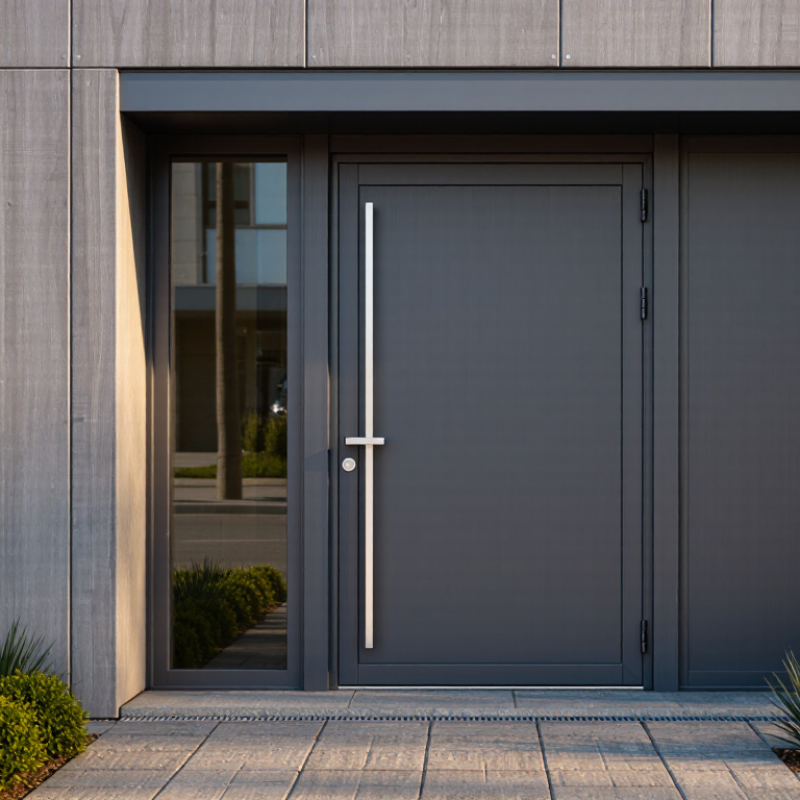
10 Tips for Choosing the Best Aluminium Entrance Door

Set performance goals: U-value, air leakage, and EN 14351-1 compliance

Choosing an aluminium entrance door starts with measurable performance goals, not appearance alone. Write down a target U-value before comparing designs. A lower U-value generally means less heat passes through the door. However, check whether the figure covers the complete doorset, including the frame, glazing, and threshold.

Air leakage deserves equal attention. A door may look precisely made yet perform poorly around its seals. Ask for air-permeability test results and confirm the stated class under EN 12207. Pay attention to corners, hinges, the lock area, and the threshold. On a windy day, these small gaps can create a noticeable cold line across the floor.

EN 14351-1 is the key product standard for external pedestrian doorsets in Europe. Request a Declaration of Performance and verify that the tested configuration matches your chosen size, glass, hardware, and opening direction. Installation also matters. A strong laboratory result can weaken through an uneven frame, compressed seal, or poorly sealed junction. That part is often underestimated. I would inspect the installed door with a smoke pencil or thermal camera where possible. It is not a perfect field test, but it can reveal uncomfortable mistakes before winter. U-values may also be presented differently, so compare like with like.

Choose thermal breaks and glazing for lower whole-door U-values

When choosing an aluminium entrance door, examine the whole-door U-value, not only the frame rating. A lower U-value means less heat passes through the complete door assembly. An attractive frame can still perform poorly.

Thermal breaks create an insulating barrier between the inner and outer aluminium sections. They reduce heat transfer and help limit cold interior surfaces. Look for a tested thermal-break system with clear performance data. Glazing also matters. Double glazing may suit moderate climates, while triple glazing can improve comfort in colder regions. Low-emissivity coatings and gas-filled cavities may reduce heat loss further. Check the spacer design too, because the glass edge can become a weak point.

I once inspected a door with excellent glass but a poorly insulated threshold. The room still felt cold near the entrance. Ask for the tested whole-door U-value, including the frame, glass, panels, threshold, and hardware. Installation deserves equal attention. Small gaps around the frame can undermine expensive glazing and thermal breaks. Use an experienced installer who follows the manufacturer’s fitting details and local building requirements. Check the air-seal line carefully. A door that closes firmly but leaks around its edges is not energy efficient. Performance claims should come from independent testing or recognised certification, not vague sales language. Even then, real results can vary with orientation, wind exposure, and indoor humidity. That uncertainty deserves attention.

10 Tips for Choosing the Best Aluminium Entrance Door - Choose Thermal Breaks and Glazing for Lower Whole-Door U-Values

Use the whole-door U-value, commonly identified as Ud, to compare entrance doors. It includes the aluminium frame, door leaf, glazing, panels, seals and thermal bridges, rather than evaluating the frame or glass alone.

Tip Selection Focus Recommended Specification Typical Performance Indicator What to Check Before Ordering
1 Compare the whole-door U-value Request a declared Ud value for the exact door size, configuration and glazing option. Ud ≤ 1.3 W/m²K is a strong target for a well-insulated entrance door; lower values indicate better thermal insulation. Do not rely only on the frame Uf or glass Ug value. A larger glazed area, threshold, hardware cut-outs and junctions can increase the final Ud.
2 Choose thermally broken aluminium profiles Select profiles with continuous polyamide thermal isolators between the internal and external aluminium sections. Thermal-break widths of approximately 20–34 mm are common in higher-performing systems. Thermally improved frames may achieve Uf around 1.5–2.0 W/m²K, depending on design. Confirm that the thermal break is continuous around the frame and door leaf, including corners and threshold areas.
3 Select suitable low-emissivity glazing Use double or triple insulating glass with a low-e coating, warm-edge spacer and inert-gas-filled cavities where appropriate. Typical centre-pane Ug values range from approximately 2.7 W/m²K for basic single glazing to about 0.6 W/m²K for high-performance triple glazing. Ask for the whole glazed panel or window-section U-value, not only the centre-of-glass figure, because spacers and edge losses affect performance.
4 Balance glazing area and insulated panels Use insulated door panels or a combination of insulated panels and high-performance glazing when thermal performance is a priority. Insulated panels may achieve approximately Up 0.6–1.0 W/m²K, while the final Ud depends on the frame, glass area and construction details. More glass can improve daylight but may increase heat loss. Compare complete door configurations at the same overall dimensions.
5 Inspect the threshold design Choose a thermally improved threshold with a low-conductivity isolator and an accessible, weather-resistant profile. A well-designed threshold helps reduce linear thermal bridging and supports better airtightness at the bottom of the door. Check the threshold height, drainage path, water-shedding detail, accessibility requirements and compatibility with the finished floor level.
6 Prioritise continuous weather seals Look for at least two effective perimeter seals, with a compression seal around the door leaf and a reliable threshold seal. Air-permeability classifications are commonly reported from Class 1 to Class 4; Class 4 represents the highest air-tightness classification under the relevant test method. Verify that seals remain continuous at corners, hinges, locks and the meeting stile. Poor adjustment can reduce real-world performance.
7 Check condensation and surface-temperature performance Use a thermally broken frame, warm-edge spacer and correctly sized glazing to limit cold internal surfaces. A higher internal surface temperature factor, often expressed as fRsi, generally indicates lower surface-condensation risk under the stated boundary conditions. Ask whether condensation-risk calculations consider the frame, glass edge, panel junctions, hardware and threshold—not just the centre of the glass.
8 Match glazing solar control to orientation Use low-e glazing for heat retention and consider solar-control glass on strong south- or west-facing elevations. Solar-energy transmittance, expressed as g-value, commonly falls within approximately 0.35–0.65; a lower g-value reduces solar heat gain. Do not select the lowest g-value automatically. Consider daylight, winter solar gains, shading, overheating risk and the local climate.
9 Evaluate security without creating thermal weak points Choose multi-point locking, reinforced keep areas and laminated security glazing where required, while preserving the thermal envelope. Security performance should be verified using an applicable classification or test report. Laminated glass can improve resistance to impact and delayed entry. Check lock positions, cylinder protection, hinge security, panel reinforcement and whether additional hardware requires drilling through thermal sections.
10 Review certified test data and installation quality Buy a door with documented thermal, air, water and wind performance for the complete tested assembly. Performance should be reported for the complete door set under relevant standards, such as EN 14351-1 and thermal calculations based on EN ISO 10077 methods where applicable. Confirm the tested size, opening direction, glazing, threshold and hardware match the proposed door. Correct installation, perimeter insulation and airtight sealing are essential.
Practical comparison example: A basic aluminium door with a non-thermally improved frame and standard double glazing may have a whole-door Ud of approximately 2.0–2.8 W/m²K. A thermally broken door with low-e double glazing may reach roughly 1.2–1.6 W/m²K, while a carefully designed thermally broken door with high-performance triple glazing can approach approximately 0.8–1.2 W/m²K. Actual results depend on door dimensions, glazing ratio, panel construction, threshold and installation.
Units: U-values are expressed in W/m²K; lower values generally indicate better thermal insulation. Values shown are realistic typical ranges for comparison, not a substitute for a certified declaration for a specific door assembly.

Verify security hardware using EN 1627 resistance classes RC2–RC3

10 Tips for Choosing the Best Aluminium Entrance Door

Verify security hardware against EN 1627 resistance classes, not attractive lock counts. RC2 doors must resist a manual attack for three minutes, while RC3 requires five minutes, according to EN 1627:2021 testing criteria.

These minutes sound brief. They are not.

Attack tools, force, glazing, hinges, and the locking cylinder are tested together.

A reliable installer should provide the complete test classification, not only an RC2 or RC3 label. Check the certificate, door dimensions, frame type, glass specification, and hardware configuration.

The European Committee for Standardization identifies attack resistance as a complete doorset performance, so upgrading one lock may not improve the whole entrance. That detail is often missed.

Industry guidance from Secured by Design also stresses laminated security glazing, protected cylinders, and properly fixed frames.

Look for multipoint locking with reinforced keeps, concealed hinge protection, and screws anchored into masonry or structural framing.

The Office for National Statistics Crime in England and Wales reports burglary as a continuing household security concern, although recorded figures vary by period and measurement method.

Do not treat a security class as an absolute guarantee. Poor installation can weaken excellent hardware, and that is where many specifications become less convincing.

Compare weather ratings under EN 12207, EN 12208, and EN 12210

Choosing an aluminium entrance door requires more than comparing finishes and handle designs.

Tip 1: Ask for a complete doorset test report, not a supplier’s general statement.

Tip 2: Check EN 12207 for air permeability. Higher classes usually indicate less unwanted draught movement.

Tip 3: Examine the tested pressure range, because laboratory performance can differ from everyday installation.

Tip 4: Review EN 12208 water tightness results. This test indicates how well the doorset resists rain under pressure.

Tip 5: Match the rating to your building’s exposure, including coastal wind and driving rain.

Tip 6: Inspect the threshold design, seals, drainage paths, and corner joints. Small gaps often matter more than attractive aluminium surfaces.

Tip 7: Confirm whether the test used the same glass, panels, locks, and dimensions you plan to order. I have seen specifications change after these details were overlooked.

Tip 8: Use EN 12210 to assess wind resistance. It covers wind load, deflection, and performance after pressure testing.

Tip 9: Ask an installer to check the opening, fixing points, and surrounding structure. A strong door can perform poorly when fitted into a weak frame.

Tip 10: Compare the tested configuration with your site conditions, not only the highest class printed in a brochure. Ratings are useful evidence, but they are not magic. Installation quality can reduce real-world performance. Recheck the sill after heavy rain. That simple observation can reveal problems early.

Assess installation quality, accessibility, warranties, and lifecycle costs

10 Tips for Choosing the Best Aluminium Entrance Door

A strong aluminium entrance door depends on installation, not appearance alone. Check whether the installer uses a level sill, continuous flashing, correctly placed shims, and low-expansion foam. Ask for photographs before the architrave covers the joints. A neat frame can still leak air or admit water. I would not trust a fitting company that cannot explain its drainage path. If possible, request an air-leakage check after installation, especially in exposed locations.

Accessibility needs practical measurement. Where applicable, ADA Standards require at least 32 inches of clear opening width and limit thresholds to ½ inch. Measure the usable opening with the door fully open, not the frame size. Confirm handle height, opening force, landing space, and smooth threshold transitions. The door should work for a wheelchair user, a delivery worker, and someone carrying groceries. Small details matter.

Lifecycle cost deserves equal attention. The International Energy Agency’s Buildings 2023 report states that buildings use about 30% of global final energy and produce 26% of energy-related emissions. Choose thermal breaks, durable seals, replaceable hardware, and finishes suited to local weather. Compare purchase, installation, cleaning, adjustment, and replacement costs over 20 years. Read the warranty carefully. Separate frame, finish, glass, hardware, and labour coverage. Look for exclusions involving coastal exposure, poor maintenance, or incorrect installation. A longer warranty is not automatically better. Its response time may be the real weakness.

20-Year Lifecycle Cost Scenario for an Aluminium Entrance Door

A transparent planning model showing how installation quality, accessibility, warranty coverage, and long-term ownership costs can affect the purchase decision.

Scenario assumptions: USD 1,400 for the door, USD 350 for professional installation, USD 30 per year for routine maintenance over 20 years, and an estimated USD 250 total energy-related impact from air leakage and thermal performance. Actual costs vary by opening size, local labour rates, climate, specification, and maintenance requirements. Confirm the clear opening, threshold design, installer qualifications, warranty terms, and replacement-part availability before ordering.

FAQS

Why should I check the whole-door U-value?

The whole-door U-value measures heat transfer through the frame, glass, panels, threshold, and hardware. A lower value usually means better insulation. A beautiful frame can still perform poorly.

How do thermal breaks improve an aluminium entrance door?

Thermal breaks separate the inner and outer aluminium sections. They slow heat transfer and reduce cold interior surfaces. Ask for tested performance data, not vague claims.

Should I choose double or triple glazing?

Double glazing may suit moderate climates. Triple glazing can improve comfort in colder regions. Low-emissivity coatings and gas-filled cavities may reduce heat loss. The glass edge matters too.

Can a well-insulated door still feel cold?

Yes. I once found excellent glass above a poorly insulated threshold. The room still felt cold near the entrance. The threshold can become the weak point.

What installation details should I inspect?

Look for a level sill, continuous flashing, correctly placed shims, and low-expansion foam. Check the air-seal line around the frame. Small gaps matter. Request joint photographs before trim covers them.

How can I check for air leakage after installation?

Ask for an air-leakage check, especially in windy or exposed locations. A door may close firmly while leaking around its edges. Inspect drainage paths and seal continuity. I would not rely on appearance alone.

What accessibility measurements deserve attention?

Measure the clear opening with the door fully open, not the frame size. Where applicable, accessibility standards may require at least 32 inches of clear width. Some standards limit thresholds to ½ inch. Also check handle height, opening force, landing space, and smooth transitions.

How should I compare long-term door costs?

Compare purchase, installation, cleaning, adjustment, and replacement costs over 20 years. Choose durable seals, suitable finishes, and replaceable hardware. A cheaper door may need earlier repairs. That assumption can be wrong.

What should I examine in the warranty?

Separate coverage for the frame, finish, glass, hardware, and labour. Check exclusions for coastal exposure, poor maintenance, and incorrect installation. A longer warranty is not automatically stronger. Response time may be the real weakness.

Conclusion

Choosing the best Aluminium Entrance Door starts with defining clear performance goals. Review the door’s U-value, air leakage, and compliance with EN 14351-1 to ensure it meets expected energy and product standards. Thermal breaks and suitable glazing can significantly reduce the whole-door U-value, improving comfort and helping control heating and cooling costs. Security should also be carefully assessed by checking the hardware, locking points, and tested resistance classes under EN 1627, particularly RC2 or RC3 where appropriate.

Weather performance is equally important. Compare air permeability under EN 12207, watertightness under EN 12208, and resistance to wind load under EN 12210. In addition to product specifications, pay close attention to installation quality, threshold accessibility, warranty coverage, maintenance needs, and expected lifecycle costs. A well-installed door with dependable hardware and durable finishes can provide better long-term value than a cheaper option with limited performance information. Evaluating all these factors together helps ensure the entrance door is secure, efficient, practical, and suitable for its building environment.

Henry

Henry

Henry is a dedicated marketing professional with a profound expertise in the company's offerings. With years of experience in the industry, he possesses an impressive understanding of the market dynamics and consumer behaviors that drive success. Henry is committed to sharing his insights through......