Choosing an Aluminum Front Door supplier in 2026 requires more than comparing catalogue photos and headline prices. Reliable suppliers should demonstrate tested materials, stable production, clear warranties, and responsive technical support. Their doors must perform across different climates, from coastal humidity to severe winter conditions.
This guide examines leading suppliers worldwide through practical purchasing criteria. These include alloy grade, thermal-break design, powder-coating quality, glass options, hardware durability, customization, and delivery capability. Factory experience matters. So does documentation. Buyers should request test reports, installation drawings, finish samples, and references from completed projects. A well-made door should open smoothly, seal tightly, and maintain its appearance after repeated exposure to sunlight and rain.
Details reveal quality. Check corner joints, drainage channels, gasket fit, hinge adjustment, and threshold construction. Small defects often become expensive problems. Supplier rankings can never fit every project perfectly. A residential renovation may need different support than a hotel or commercial development. Prices, lead times, certifications, and export policies may also change during 2026. Verify them directly.
Not every attractive door is a dependable investment. Some suppliers communicate well before payment but respond slowly after delivery. That risk deserves attention. This overview combines industry knowledge, supplier research, and practical evaluation points to help buyers compare manufacturers more confidently. It is not a substitute for professional site assessment. Still, it offers a clearer starting point for selecting doors that balance design, security, energy performance, and long-term value.
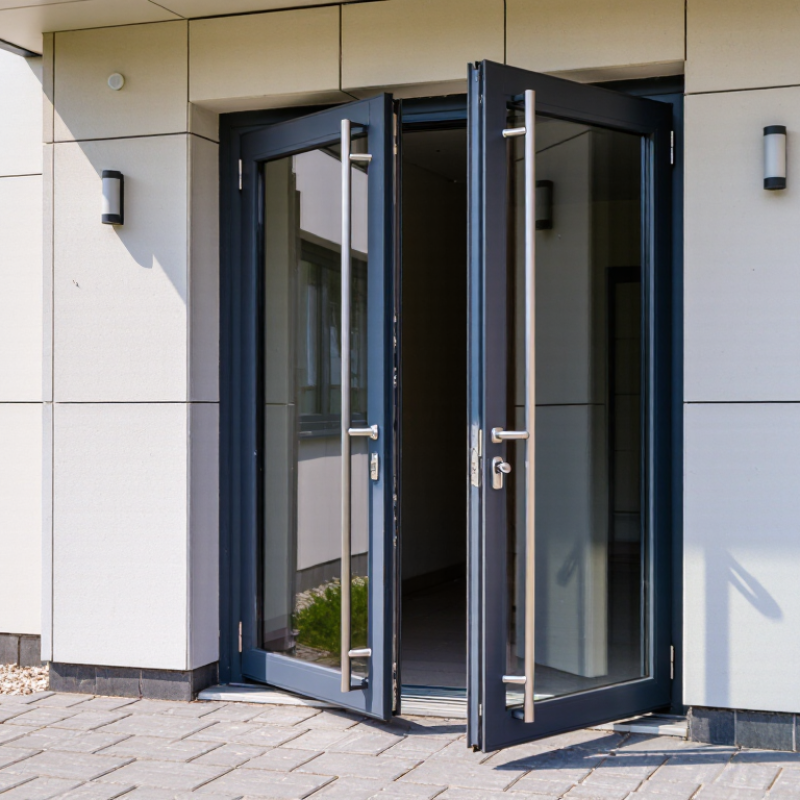
The global aluminum door market is entering 2026 with steady, construction-led demand. Grand View Research estimates the sector could grow at roughly 4.8% annually through 2030. Demand is strongest where cities are expanding and energy codes are tightening. Asia-Pacific remains the largest regional engine, supported by urban housing, transport hubs, and commercial towers. China, India, and Southeast Asia are especially active.
North America and Europe show a different pattern. Replacement projects, renovation programs, and low-energy building standards are driving purchases. Fortune Business Insights reports continued growth in the broader aluminum doors and windows market, with energy efficiency remaining a major purchasing factor. In practical terms, buyers increasingly request thermal breaks, insulated glazing, durable powder coatings, and tested air-tightness. A poorly specified frame can still create cold edges and indoor drafts.
Regional conditions matter. Coastal projects need stronger corrosion protection, while hot climates require careful solar-control glass selection. Suppliers with verified test reports, stable extrusion quality, and documented factory controls deserve closer attention. Yet market forecasts are not perfectly aligned. Report boundaries differ, and 2026 construction activity may change with interest rates, material costs, and public infrastructure spending. Forecasts need checking. Procurement teams should compare delivered performance, not only catalog dimensions or quoted prices.
Choosing among the 2026 top aluminum front door suppliers requires more than comparing frame finishes. Thermal data should guide the shortlist. U-factor measures heat transfer through the complete door assembly, usually in W/m²K. A lower value indicates better insulation, but the declared boundary matters. Some suppliers quote center-panel results, while others report whole-door performance. That difference can distort comparisons.
SHGC shows how much solar energy enters through the glazed portion. Values range from zero to one. Lower SHGC can reduce summer cooling demand, while higher values may support passive heating. Climate, orientation, glass coating, and shading should influence the target. An experienced evaluator checks glass, frame, seals, thermal breaks, and spacers together. The best brochure number is not always the best installed result. Site workmanship still matters.
For European projects, EN 14351-1 supports performance assessment for external pedestrian doorsets. Ask for test reports, declared values, air permeability, watertightness, and wind-load evidence. Confirm that documents match the exact size, glass build-up, hardware, and threshold. Factory quality records and independent laboratory testing strengthen supplier reliability. A recurring project lesson is uncomfortable: specifications can weaken after substitutions. The comparison is not perfectly clean. Suppliers should explain limitations clearly, rather than hiding behind a single U-factor.
Choosing top aluminum front door suppliers in 2026 requires more than comparing prices or profile thickness. Certification scope matters. AAMA testing evaluates air leakage, water penetration, structural performance, and operational durability. WDMA certification adds product performance, material quality, and manufacturing consistency. CSA A440 is especially relevant for Canadian projects, where severe temperature changes can expose weak seals quickly. CE marking confirms conformity with applicable European requirements, but it is not automatically proof of superior performance.
Performance data deserves close attention. The International Energy Agency’s Buildings 2024 report states that buildings consume about 30% of global final energy. Door selection therefore affects more than appearance. Ask suppliers for tested U-values, air-infiltration results, water-pressure ratings, thermal-break details, and hardware-cycle evidence. A low U-value looks impressive. It may still fail if installation tolerances are poor. Small gaps matter.
Global supplier comparisons should also verify factory traceability and certificate validity. Product certificates must match the exact door system, glass package, dimensions, and hardware configuration. This is often overlooked. WDMA and AAMA documents can support North American specification work, while CSA A440 helps confirm Canadian suitability. For European projects, review the Declaration of Performance and CE documentation under the relevant harmonized standard. A certificate is not a guarantee. It is evidence, and evidence needs context. Suppliers unable to provide recent laboratory reports deserve careful reconsideration.
| Evaluation Dimension | AAMA / FGIA Requirements | WDMA Hallmark Program | CSA A440 Series | CE Marking in the European Market | Evidence to Request from a Supplier |
|---|---|---|---|---|---|
| Primary geographic relevance | United States and projects using U.S. fenestration performance specifications. | United States and North American projects requiring third-party product certification. | Canada and projects specifying Canadian window, door, or skylight requirements. | European Economic Area and other markets accepting applicable European harmonized standards. | A project-specific compliance matrix showing the destination market and applicable code. |
| Status of the framework | AAMA standards are now administered within the Fenestration and Glazing Industry Alliance (FGIA); many specifications still reference AAMA designations. | A certification program operated by the Window & Door Manufacturers Association for qualifying fenestration products. | A Canadian Standards Association product-standard framework; the exact edition and product scope must be verified. | A legal conformity-marking system, not a single universal product-quality certificate. | Current certificates, declarations, test reports, and the standard edition cited on each document. |
| Typical product scope | Aluminum windows, doors, storefronts, curtain walls, and related fenestration assemblies, depending on the referenced specification. | Certified window and door product lines, including performance-rated residential and light-commercial fenestration. | Windows, doors, and skylights covered by the applicable CSA A440 requirements and associated Canadian performance classifications. | External pedestrian doorsets and windows within the scope of the applicable harmonized European product standard. | Exact product description, opening configuration, frame material, glazing type, hardware, and maximum tested size. |
| Air infiltration performance | Measured and classified under the applicable AAMA/FGIA test method; pass criteria depend on product type and performance class. | Reported as part of the product performance rating and verified through the program’s certification process. | Evaluated under Canadian test and classification requirements; the specified class must match the project. | Declared using the applicable European classification system and test method; values are product-specific. | Full air-leakage test result, classification, pressure conditions, laboratory, and tested assembly configuration. |
| Water penetration resistance | Determined through standardized water-penetration testing and reported with the tested pressure or rating. | Included in the certified performance profile where required by the product category. | Tested and classified according to the applicable Canadian standard and product type. | Declared using European water-tightness classifications applicable to the tested product. | Test pressure, pass/fail result, drainage details, sill design, glazing configuration, and installation assumptions. |
| Structural performance | Typically expressed through design pressure or performance-grade information supported by laboratory testing. | Certification identifies the performance rating of the approved product configuration. | Canadian performance classifications address structural and weather-related requirements for covered products. | Declared through European resistance-to-wind and related classifications where required by the applicable standard. | Design pressure, wind-load basis, mullion or panel limits, maximum dimensions, and engineering calculations where applicable. |
| Thermal performance | U-factor and solar heat-gain data are generally provided through NFRC procedures or project-specified calculation methods rather than by AAMA alone. | May list product performance, but thermal values must be checked against the applicable NFRC or project calculation documentation. | Thermal compliance depends on the applicable Canadian energy code, product specification, and declared U-value or RSI value. | Thermal transmittance and solar-performance declarations depend on the applicable European assessment method. | Declared U-value, glazing build-up, spacer type, frame thermal break, calculation method, and center-of-glazing assumptions. |
| Third-party verification | Often supported by accredited laboratory reports, product certifications, or code-evaluation documentation; AAMA reference alone is not proof of certification. | Designed around independent certification, periodic inspections, and ongoing product-labelling controls. | Verification depends on the certification route and the authority or laboratory identified in the documentation. | May require notified-body involvement depending on the applicable conformity-assessment system and product characteristics. | Accreditation scope of the laboratory or certification body, certificate validity, surveillance records, and product listing. |
| Fire and smoke applications | Requires separate fire-rated door or assembly standards; ordinary exterior-door ratings do not automatically provide fire resistance. | Standard Hallmark performance certification should not be treated as a fire-rating certificate. | Fire and smoke performance requires separate applicable Canadian standards and tested assemblies. | External doorsets with fire or smoke characteristics generally require the applicable fire-product standard in addition to the ordinary external-door standard. | Fire test report, smoke-control classification, hardware schedule, glazing details, wall interface, and approved size range. |
| Best use in supplier selection | Confirming compliance with U.S. project specifications, performance grades, and local building-code requirements. | Shortlisting manufacturers with independently monitored product certification and traceable product labels. | Checking suitability for Canadian climate, code, and fenestration performance requirements. | Confirming legal market access and declared performance for the intended European destination. | Compare complete technical files rather than comparing logos, marketing claims, or certificates without product identification. |
Choosing an aluminum front door supplier in 2026 requires more than comparing finishes and delivery dates. Recycled content should be reported as a percentage, with pre-consumer and post-consumer material listed separately. Reliable suppliers can provide production records, environmental product declarations, or independent certification. These documents make sustainability claims easier to test.
Aluminum recycling can use up to 95% less energy than producing primary aluminum from ore. That figure matters when a supplier uses scrap from old doors, window frames, and industrial components. However, the result depends on electricity sources, transport distance, alloy quality, and furnace efficiency. Ask whether the recycled material is processed locally or shipped across several regions. Small details matter.
During a factory review, I would check scrap bins, remelting records, and powder-coating waste. Real evidence is often less polished than a brochure. The metric is not perfect. A door with high recycled content may still carry emissions from glass, insulation, packaging, or long-distance delivery. Suppliers should disclose these limits instead of presenting one percentage as the whole environmental story. Buyers can also request the expected service life, repair options, and end-of-life recovery plan. Durable frames, replaceable hardware, and recyclable components may reduce impact over decades. That is practical sustainability.
For 2026 aluminum front door sourcing, MOQ should match project risk, not only unit price. A low MOQ supports custom trials, but it may increase tooling and packaging costs. Request a sample before approving a container order. Ask for monthly capacity, current utilization, and production bottlenecks. Claimed capacity is not verified capacity. A factory visit, audit, or recent inspection record adds useful evidence.
Lead time needs a milestone schedule. It should separate drawing approval, extrusion, finishing, glazing, assembly, and shipment. A supplier quoting 30 days may exclude approval and ocean transit. The World Bank’s 2023 Logistics Performance Index evaluates customs, infrastructure, logistics services, and timeliness on a one-to-five scale. Use those risks when comparing delivery promises. Ask for late-shipment remedies in writing.
Warranty terms must identify coating, seals, hardware, glass, and installation exclusions. “Ten years” means little without maintenance conditions. Total cost also includes freight, duties, unloading, installation, replacement parts, and energy performance. The 2023 Global Status Report for Buildings and Construction reported that buildings consumed 32% of global energy and produced 34% of global carbon emissions in 2022. Better thermal breaks and weather seals can reduce operating costs, although payback varies by climate. I would not trust the cheapest quote alone. A three-year cost model, supported by test reports and inspection data, is more defensible than a glossy capacity claim.
Current forecasts suggest annual growth of about 4.8%. Results may change with interest rates, material prices, and construction spending.
Asia-Pacific leads demand, especially in China, India, and Southeast Asia. Urban housing, transport hubs, and office towers support growth.
Replacement work, renovation programs, and stricter energy rules are major drivers. Buyers often seek better insulation and fewer indoor drafts.
Ask for tested U-values, air-leakage results, water-pressure ratings, and thermal-break details. Hardware-cycle evidence is useful too.
No. Poor installation can create cold edges and small air gaps. The frame, glass, seals, and installation must work together.
Coastal buildings need stronger corrosion protection. Hot climates may require solar-control glass. Severe winters can quickly expose weak seals.
Confirm that documents match the exact door system, glass package, dimensions, and hardware. Check recent laboratory reports and factory traceability.
Recycling aluminum can use up to 95% less energy than producing primary aluminum. The actual saving depends on electricity, transport, and furnace efficiency.
Request recycled content percentages, separated by material source. Also review production records, emissions data, service life, repair options, and recovery plans.
Not really. Glass, insulation, packaging, and long-distance shipping also affect emissions. The environmental story remains incomplete.
The 2026 global Aluminum Front Door market is expected to benefit from rising demand for energy-efficient, durable, and customizable entrance systems. Growth will be supported by residential construction, renovation projects, and expanding opportunities across key regional markets. Buyers should evaluate thermal performance through U-Factor and SHGC ratings, while confirming compliance with EN 14351-1 and relevant regional certification frameworks, including AAMA, WDMA, CSA A440, and CE requirements.
Sustainability will remain a major purchasing factor, particularly the use of recycled aluminum, which can require up to 95% less energy than producing primary aluminum. When comparing suppliers, buyers should assess minimum order quantities, production capacity, lead times, warranty coverage, quality control, customization options, and total cost of ownership. A reliable supplier should balance certified performance, consistent manufacturing, responsible material sourcing, and dependable after-sales support to meet the diverse requirements of global projects in 2026.
Primeval Doors